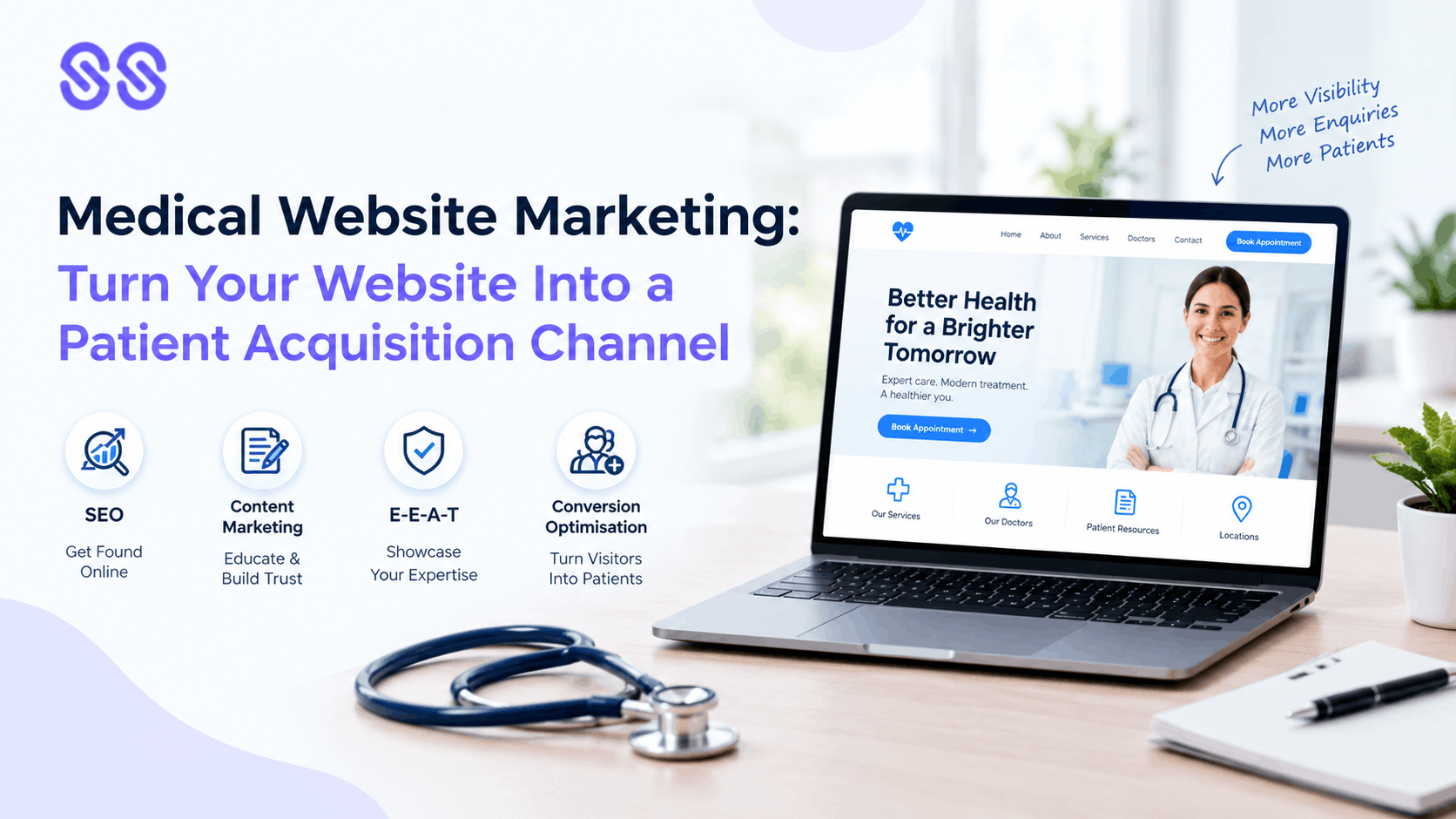
A medical website should do more than provide an online brochure for a doctor or clinic. For many prospective patients, the website is one of the first places they go after discovering a healthcare provider through Google, social media, advertising, referrals or online directories.
If the website only provides basic information and a phone number, it may be missing opportunities to educate visitors, establish trust and generate enquiries.
This is where medical website marketing becomes important.
A well-planned medical website can work as a patient acquisition channel by connecting search visibility, useful healthcare content, professional expertise, local information and conversion-focused design. Instead of simply attracting visitors, the website can guide relevant users from their initial search through research and evaluation toward an appropriate enquiry or appointment.
The objective is not to turn every visitor into a patient.
The objective is to make the website useful enough for the right visitors to understand the practice, evaluate its services and take the next appropriate step.
What Is Medical Website Marketing?
Medical website marketing is the process of using a healthcare website to attract relevant audiences, communicate a practice's expertise and services, build trust and encourage appropriate patient enquiries.
It can combine:
- Healthcare SEO
- Content marketing
- Local SEO
- Service-page optimisation
- Doctor profile optimisation
- Conversion rate optimisation
- Paid search landing pages
- Website performance
- Internal linking
- Reputation and trust signals
- Patient-focused content
A website should work together with the practice's broader digital marketing strategy rather than operate independently.
For example:
Google Search → Medical Website → Service Page → Doctor Information → Trust Evaluation → Appointment Enquiry
This creates a clearer patient journey.
Also Read More - Best Digital Marketing Strategies for Ophthalmology Clinics
Why a Medical Website Should Be More Than an Online Brochure
A traditional brochure-style website might contain:
- Home
- About
- Services
- Contact
This structure can be useful as a starting point, but it may not provide enough depth to capture different types of healthcare searches.
Patients may search for:
- Specific conditions
- Symptoms
- Treatments
- Doctors
- Specialties
- Locations
- Procedures
- Appointment information
A strong website should have relevant pages that address these different search intents.
For example, a dermatology practice may need dedicated pages for:
- Dermatology
- Acne treatment
- Mole assessment
- Skin cancer screening
- Hair loss treatment
- Doctor profiles
- Clinic locations
This creates more opportunities for relevant users to discover the practice.
Start With Patient Search Intent
Effective healthcare website marketing begins with understanding what potential patients are searching for.
Not all searches have the same intent.
Informational Intent
Examples:
- What causes persistent back pain?
- What are the symptoms of eczema?
- When should I see a cardiologist?
These searches usually require educational content.
Service Intent
Examples:
- Dermatology clinic
- Physiotherapy treatment
- Dental implants
- Cataract surgery
These searches are better suited to service pages.
Local Intent
Examples:
- Dermatologist near me
- Cardiologist in Miami
- Private GP in London
These searches require strong local relevance.
Transactional Intent
Examples:
- Book dermatologist appointment
- Private GP consultation
- Physiotherapy appointment
These users may be closer to taking action.
Mapping these intents to the right pages helps create a more effective website structure.
Build High-Quality Service Pages
Service pages are often central to medical website conversion.
A strong service page should answer the questions a prospective patient is likely to have before contacting the practice.
Depending on the service, include:
- What the service is
- Conditions or concerns addressed
- Who provides the service
- What an assessment may involve
- Treatment information
- Relevant risks or considerations where appropriate
- Clinic location
- Appointment information
- Frequently asked questions
The content should be medically responsible and avoid guarantees.
For example, instead of simply writing:
“We provide advanced knee treatment.”
a stronger page can explain what the service involves, who provides it and what patients can expect from the consultation process.
Useful information creates more value than promotional language alone.
Create Detailed Doctor Profiles
Patients often want to know who will provide their care.
Doctor profiles can therefore support both SEO and patient conversion.
A useful profile can include:
- Full professional name
- Qualifications
- Relevant training
- Areas of expertise
- Professional experience
- Treatments or procedures provided
- Professional memberships where applicable
- Languages spoken
- Clinic locations
- Appointment information
All information should be accurate and verifiable.
Avoid adding qualifications, awards, memberships or professional claims that cannot be substantiated.
For healthcare websites, genuine expertise is far more valuable than exaggerated marketing copy.
Make E-E-A-T Visible Across the Website
Healthcare is a trust-sensitive sector, which makes E-E-A-T particularly important.
E-E-A-T stands for:
- Experience
- Expertise
- Authoritativeness
- Trustworthiness
These principles should be reflected throughout the website.
Experience
Provide accurate information about the practice, its services and the patient journey.
Expertise
Clearly identify qualified healthcare professionals and their areas of practice.
Authoritativeness
Use reputable medical references and professional information where appropriate.
Trustworthiness
Provide accurate contact information, transparent organisation details and responsible healthcare content.
E-E-A-T should not be treated as a collection of artificial SEO signals.
It should reflect the real expertise and credibility of the practice.
Build Healthcare Content Around Real Patient Questions
Educational content can bring potential patients to the website before they are ready to contact a doctor.
Examples include:
- What are the early symptoms of arthritis?
- When should I see a dermatologist?
- What happens during a first physiotherapy appointment?
- How is cataract surgery performed?
- What should I expect during a cardiology consultation?
This type of content can support the top and middle stages of the patient journey.
The content should educate rather than diagnose individual readers.
Where appropriate, it should also explain when a person should consider seeking professional medical advice.
Connect Blog Content With Commercial Pages
One common problem with healthcare websites is publishing blogs that operate independently from service pages.
A stronger structure creates logical internal links.
For example:
Blog: What Causes Persistent Shoulder Pain?
↓
Condition Page: Shoulder Pain
↓
Service Page: Shoulder Pain Treatment
↓
Doctor Page: Shoulder Specialist
↓
Location Page: Shoulder Specialist in Miami
↓
Appointment: Request a Consultation
This approach allows educational content to support relevant commercial pages without turning every article into an advertisement.
Optimise the Website for Local Patients
For practices with physical locations, local search can be an important part of healthcare website optimization.
The website should make it easy to find:
- Clinic address
- Phone number
- Opening hours
- Directions
- Services
- Doctors
- Parking information where relevant
- Accessibility information
- Appointment options
Genuine clinic locations can have dedicated location pages.
Each page should contain useful information specific to that location rather than simply changing the city name on a duplicated template.
Make Contact Information Impossible to Miss
One of the simplest ways to improve medical website conversion is to make contact options obvious.
A visitor should not have to search through the website to find:
- Phone number
- Appointment button
- Contact form
- Clinic address
- Booking information
Consider placing appropriate CTAs in:
- Header
- Service pages
- Doctor profiles
- Location pages
- Relevant blog posts
- Footer
The exact placement should depend on the website design and patient journey.
Create Clear Calls to Action
A call to action should tell the visitor what they can do next.
Examples include:
- Book an Appointment
- Request a Consultation
- Contact the Clinic
- Call the Practice
- Find Our Location
- Meet the Specialist
Different pages may require different CTAs.
For example, an educational article may use:
“Explore our treatment options”
while a high-intent service page may use:
“Request an Appointment.”
This creates a more natural patient journey.
Improve the Mobile Patient Experience
A large proportion of healthcare searches can happen on mobile devices.
A medical website therefore needs to work well on smaller screens.
Review:
- Page speed
- Font size
- Navigation
- Button placement
- Form usability
- Click-to-call functionality
- Appointment buttons
- Address visibility
- Map functionality
A patient who discovers a clinic on a smartphone should be able to understand the service and contact the practice without unnecessary friction.
Improve Website Speed and Technical SEO
Good healthcare website optimization includes the technical foundation behind the visible content.
Important areas include:
- Crawlability
- Indexation
- XML sitemap
- Robots.txt
- Canonical tags
- Redirects
- Broken links
- Mobile usability
- Page performance
- HTTPS
- Structured data where appropriate
Technical SEO does not replace useful content, but technical problems can prevent valuable pages from being properly discovered or understood by search engines.
Use Structured Data Appropriately
Healthcare websites can use relevant structured data to help search engines understand information about the organisation, professionals and other entities.
Depending on the website, this may include appropriate schema for:
- Organisation
- Local business
- Healthcare professionals
- Services
- Articles
Structured data should accurately represent information visible on the page.
It should not be used to add claims or information that users cannot actually find on the website.
Use Medical Content Marketing to Build Authority
A strong content strategy should go beyond publishing random blog posts.
Create content around topics that relate to the practice's actual areas of expertise.
For example, a cardiology practice could build a content cluster around heart health:
Core Service
Cardiology Services
Supporting Topics
- What does a cardiologist do?
- When should you see a cardiologist?
- What happens during a cardiology consultation?
- Common heart conditions
- Understanding cardiac tests
Each article can link to relevant service and doctor pages.
This helps create a connected information architecture while providing useful resources to patients.
Use Reviews as a Trust Signal
Genuine patient reviews can influence how prospective patients evaluate a healthcare practice.
A practice should:
- Encourage authentic feedback where appropriate
- Respond professionally
- Address legitimate concerns
- Keep business information accurate
Avoid creating fake reviews or misleading testimonials.
Reviews should reflect real patient experiences and comply with applicable platform, professional and privacy requirements.
Make Appointment Forms Simple
Long and complicated forms can create unnecessary friction.
Only request information that is appropriate and necessary for the enquiry stage.
A basic form may include:
- Name
- Contact information
- Preferred service
- Preferred appointment details
The exact fields depend on the practice's operational requirements and privacy obligations.
If a person is ready to enquire, the website should not make the process unnecessarily difficult.
Read More - Best Website Features for Modern Dental Clinics
Connect Medical Website Marketing With Google Ads
Paid search can drive high-intent visitors directly to specific service pages.
For example:
Google Search: “private dermatologist in London”
↓
Google Ad: “Private Dermatology Consultation”
↓
Landing Page: Dermatology Consultation
↓
CTA: Request an Appointment
The landing page should match the advertisement and search intent.
Sending every paid visitor to the homepage can make the journey less direct.
Measure Patient Conversion, Not Just Traffic
One of the most important parts of medical website marketing is measurement.
Track meaningful actions such as:
- Phone calls
- Appointment requests
- Contact forms
- Online bookings
- Consultation requests
- Location interactions
- Service-page conversions
Useful metrics can include:
- Organic conversion rate
- Landing-page conversion rate
- Cost per lead
- Cost per appointment
- Qualified lead rate
- Service-level conversion
- Location-level performance
The objective is to understand which pages and channels contribute to meaningful patient enquiries.
Identify Where Patients Drop Off
Think about the website as a funnel:
Search → Landing Page → Engagement → Service Evaluation → Enquiry → Appointment
If many people reach the website but very few contact the practice, investigate the conversion stage.
If people leave quickly from important pages, investigate:
- Content relevance
- Page speed
- Mobile usability
- Search intent
- Page structure
If enquiries are high but appointments are low, the problem may be further down the patient journey.
This approach prevents the practice from trying to solve every marketing problem with more traffic.
Use Analytics to Make Better Marketing Decisions
Analytics should answer practical questions.
For example:
- Which services attract the most organic visitors?
- Which pages generate enquiries?
- Which locations perform best?
- Which traffic sources produce qualified leads?
- Which landing pages have low conversion rates?
- Which content assists the patient journey?
Privacy and healthcare requirements should always be considered when implementing analytics and conversion tracking.
The goal is to collect useful information responsibly rather than track everything possible.
Read More - Digital Marketing for Doctors: Complete 2026 Guide to Patient Acquisition
Common Medical Website Marketing Mistakes
Treating the Website as a Brochure
A healthcare website should actively support discovery, education and conversion.
Creating One Generic Services Page
Important services may require dedicated pages.
Publishing Content Without Internal Links
Disconnected blog posts may fail to support the rest of the website.
Hiding Contact Information
Patients should be able to contact the practice easily.
Ignoring Mobile Users
A poor mobile experience can create unnecessary conversion friction.
Using Generic Medical Content
Content should reflect the practice's real expertise and patient needs.
Making Unsupported Medical Claims
Healthcare marketing should prioritise accuracy and trust.
Focusing Only on Traffic
The purpose of acquisition is not traffic for its own sake. Meaningful enquiries and appropriate patient actions matter.
A Step-by-Step Medical Website Conversion Strategy
Step 1: Audit Existing Performance
Review traffic, rankings, conversions, technical SEO and user experience.
Step 2: Identify Priority Services
Determine which services are most important to the practice.
Step 3: Map Search Intent
Connect informational, service, local and appointment searches to appropriate pages.
Step 4: Improve Service Pages
Create useful, trustworthy pages that answer patient questions.
Step 5: Strengthen Doctor Profiles
Make professional expertise easy to understand and verify.
Step 6: Build Helpful Content
Create educational resources around genuine patient questions.
Step 7: Improve Internal Linking
Connect blogs, services, doctors and locations logically.
Step 8: Improve Conversion Paths
Make calls, forms and appointment options easy to access.
Step 9: Improve Technical Performance
Resolve crawlability, indexation, speed and mobile issues.
Step 10: Measure and Refine
Use conversion data to identify opportunities and improve the patient journey.
Also Read About - Oral Surgeon Marketing: Complete SEO, Google Ads & Patient Acquisition Guide for Oral and Maxillofacial Surgeons
Final Thoughts
Turning a medical website into a patient acquisition channel requires more than increasing traffic.
Effective medical website marketing connects search visibility with useful information, professional expertise, local relevance, trust and a clear conversion path.
A strong website helps prospective patients move from:
“I have a healthcare question”
to:
“I understand my options”
to:
“I want to learn more about this practice”
and eventually:
“I know how to contact the practice.”
That journey is supported by healthcare website marketing, medical website conversion, healthcare website optimization and patient conversion working together.
For doctors and medical practices, the website should not simply tell people that the practice exists. It should help the right people understand what the practice provides, who provides it, where it is available and what the appropriate next step is.
When SEO, content, local visibility, E-E-A-T, technical performance and conversion optimisation are aligned, the medical website can become one of the most valuable assets in the practice's broader patient acquisition strategy.